
Question 1: Strengthening Collective Bargaining for Maryland State Workers
Maryland voters will have an opportunity this November to strengthen collective bargaining for Maryland State employees and ensure that negotiated agreements are accounted for in the State budget.
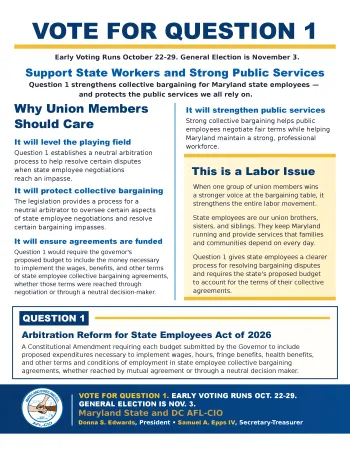
Question 1, the Arbitration Reform for State Employees Act of 2026, would establish a process for resolving certain bargaining disputes when State employee unions and the State reach an impasse. It would also require the Governor’s proposed budget to include the funding necessary to implement State employee collective bargaining agreements — including terms reached through a neutral arbitrator.
Question 1 Is About Collective Bargaining
State employees bargain collectively with the State over wages, hours, benefits and other terms and conditions of employment. Question 1 would change how certain disputes are resolved when negotiations reach an impasse.
Under the measure, a neutral arbitrator can be selected to oversee certain aspects of State employee collective bargaining, including a process for resolving certain bargaining impasses.
The goal is not to guarantee that labor wins or management wins. Instead, Question 1 establishes a defined process for resolving certain disputes when the parties cannot reach an agreement.
Making Sure Agreements Are Reflected in the State Budget
Question 1 would also connect the collective bargaining process to the State’s budget process.
The constitutional amendment would require each budget submitted by the Governor to include proposed expenditures necessary to implement the wages, hours, fringe benefits, health benefits and other terms and conditions contained in State employee collective bargaining agreements.
That requirement would apply whether those terms were reached through negotiations between the State and its employees or through a neutral decision maker.
In other words, when State employees reach a collective bargaining agreement, the State budget process would have to account for the costs of implementing that agreement.
Why Question 1 Matters to All Union Members
You don't have to be a State employee to understand why collective bargaining matters.
Public employees across Maryland provide services that families, communities and businesses depend on. When workers have a meaningful voice at the bargaining table, it strengthens the principle of collective bargaining for workers throughout Maryland.
That is why Question 1 is a labor-to-labor issue.
The Maryland State & DC AFL-CIO represents a labor movement made up of workers from many different unions, industries and workplaces. Standing with State workers means standing up for the principle that workers should have a meaningful voice in determining their wages, benefits and working conditions.
What Question 1 Does — and Doesn't — Do
Question 1 does not guarantee that unions will get everything they ask for at the bargaining table.
An arbitration process does not mean that either side automatically gets its preferred outcome. Rather, it creates a defined process for resolving certain disputes when negotiations reach an impasse.
And Question 1 is about more than wages. The constitutional amendment specifically addresses wages, hours, fringe benefits, health benefits and other terms and conditions of employment.
Standing Together for Collective Bargaining
Strong collective bargaining benefits workers across the labor movement.
State employees are union members just like workers in other public- and private-sector workplaces. The rules governing their bargaining process are part of the broader effort to protect workers' voices at the bargaining table.
Question 1 is an opportunity for Maryland voters to strengthen that voice, establish a clear process for resolving certain bargaining disputes, and ensure that State employee collective bargaining agreements are accounted for in the Governor's proposed budget.
This November, vote FOR Question 1. Stand with State workers. Stand for collective bargaining.
Download a flyer about Question 1: